Futuristic Delivery Scooter Robot: Graphics for Crafts
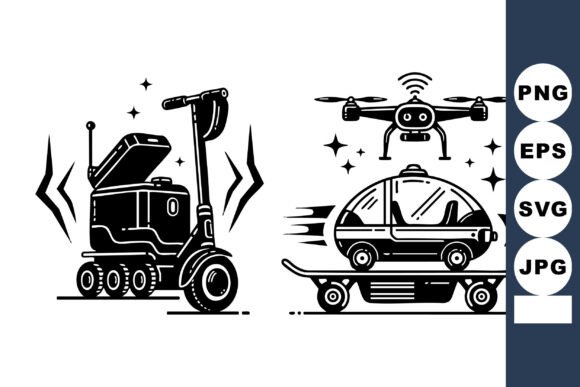
When I first opened the file for the Futuristic Delivery Scooter Robot, my immediate reaction was one of amused curiosity. As a designer who spends most of my week balancing corporate minimalism with the need for eye-catching marketing visuals, this asset stood out as a refreshing departure from the norm. The piece is a playful monochrome vector illustration that layers a whimsical narrative: a robot on a scooter, a hovering drone, and a self-driving pod car zipping along on a giant skateboard. It is not just a random collection of tech icons; it is a cohesive scene that tells a story about speed, automation, and the future of logistics. For designers working in the Crafts and Graphics sectors, finding an illustration that balances technical themes with a lighthearted, approachable vibe is often a challenge, but this asset nails that intersection.
Visual Mood and Brand Fit
The visual language here is distinctly modern yet accessible. The monochrome palette ensures versatility, allowing the graphic design asset to slot seamlessly into existing brand color schemes without clashing. I recently considered this for a client launching a local same-day delivery service for handmade goods. They needed branding that felt high-tech enough to promise efficiency but friendly enough to appeal to a community-focused audience. The Futuristic Delivery Scooter Robot provided exactly that emotional bridge. It avoids the cold, sterile look of typical corporate tech imagery and instead injects a sense of fun and innovation. This makes it an ideal candidate for small business branding where personality is a key differentiator.
For content creators and bloggers covering topics like urban mobility, green technology, or the gig economy, this illustration serves as a perfect editorial header. It breaks up text-heavy articles with a visual that is engaging without being distracting. The style suggests a modern design aesthetic that fits well within tech editorials, startup pitch decks, and even educational materials explaining supply chain innovations to younger audiences.
Real-World Application in Client Projects
In terms of practical application, the versatility of this digital product is impressive. Because it is a vector-based illustration, it scales infinitely without losing quality, making it suitable for everything from tiny sticker design elements to large-format packaging design. I can easily envision this used as a hero graphic on a landing page for a logistics app, or printed on the side of a delivery van wrap to create instant brand recognition.
For the print-on-demand market and Etsy product sellers, this asset offers significant potential. The playful nature of the robot and the skateboard pod makes it a strong contender for t-shirt design, particularly for niche audiences interested in sci-fi, coding, or futurism. It would also work exceptionally well on tote bags, mugs, and laptop sleeves. If you are creating a Canva template for tech startups or a Cricut project for a maker space event, the clean lines and clear shapes ensure that the design cuts cleanly and prints sharply.
Furthermore, for marketers running social media campaigns, this image acts as a powerful hook. On platforms like Instagram or Pinterest, where visual stop-power is crucial, the unique combination of a drone, a robot, and a skateboard creates a "double-take" moment that increases engagement. It transforms a standard post about delivery times into a piece of shareable content.
Strategic Placement and Layout Considerations
While the asset is robust, knowing where to place it is key to maintaining a professional output. This illustration shines in large layout areas where its details can be appreciated. It works best as a focal point in product mockups, decorative accents on website headers, or as the central theme in a seasonal campaign visual. When used in packaging details, such as a thank-you card insert or a box flap graphic, it adds a layer of delight to the unboxing experience.
However, caution is required when deploying this in constrained environments. Due to the complexity of the scene—with three distinct moving elements stacked vertically—it may lose clarity at very small sizes. If you are designing a favicon or a tiny app icon, the details of the hovering drone or the skateboard wheels might blur together. Similarly, in crowded layouts with heavy text or busy backgrounds, the monochrome lines could get lost. It is not ideally suited for minimalist branding projects that rely on extreme simplicity or for professional corporate materials that require a strictly conservative tone, such as legal documents or financial reports. In these cases, the playful nature might undermine the desired seriousness.
Impact on Hierarchy and Brand Perception
Integrating the Futuristic Delivery Scooter Robot into a design system affects the overall visual hierarchy. Because it is illustrative and detailed, it naturally draws the eye. Designers must ensure it supports, rather than competes with, the primary call-to-action or headline. When used correctly, it enhances brand consistency by establishing a tone of innovation and friendliness. It builds visual trust by showing that the brand is forward-thinking, while the whimsical elements foster emotional appeal and audience engagement. It signals that the business doesn't take itself too seriously, which can be a massive advantage in building rapport with consumers.
Essential Designer Notes and Technical Checks
Before finalizing any client deliverable with this asset, there are several practical steps I always recommend. First, test it in black and white to ensure the contrast holds up if the client decides to print on colored stock or use it in grayscale publications. Check the contrast on light and dark backgrounds; while monochrome is flexible, a dark gray line on a black background will vanish. Always preview it at small and large sizes to confirm legibility across different devices.
If you are using this for physical goods, place it on real mockups to see how the lines interact with textures like fabric or cardboard. Test print quality specifically for fine lines to ensure no bleeding occurs during production. Review the file formats provided; if it includes an SVG design, verify the editability of individual nodes so you can recolor specific elements like the drone or the skateboard if the brand guidelines require it. If it is a PNG design, inspect the transparency to ensure there are no unwanted white halos around the edges.
Typography pairing is another critical consideration. This illustration pairs beautifully with geometric sans serif fonts that echo its modern feel, or even chunky display fonts for a bold statement. Avoid delicate script fonts or overly traditional serif fonts, as they may clash with the futuristic theme. Finally, and most importantly, always confirm commercial licensing before using this for a client or business project. Ensure the license covers your intended use case, whether it's for a commercial design agency, a handmade business, or a design bundle you intend to resell.
In conclusion, the Futuristic Delivery Scooter Robot is a versatile and charming asset that bridges the gap between technical subject matter and approachable design. For designers willing to test its limits and apply it strategically, it offers a unique way to elevate marketing visuals, web design, and editorial design projects with a touch of futuristic flair.